
Feedback CV
| Property | Value |
|---|---|
| Category | Special |
| Voltage Range | -5V..+5V |
| Polarity | Bipolar |
| Bandwidth | Variable (DC to audio-rate) |
Description
Feedback CV arises when a module's output is patched back into its own input (self-modulation). This creates chaotic, self-reinforcing, or self-oscillating behaviors.
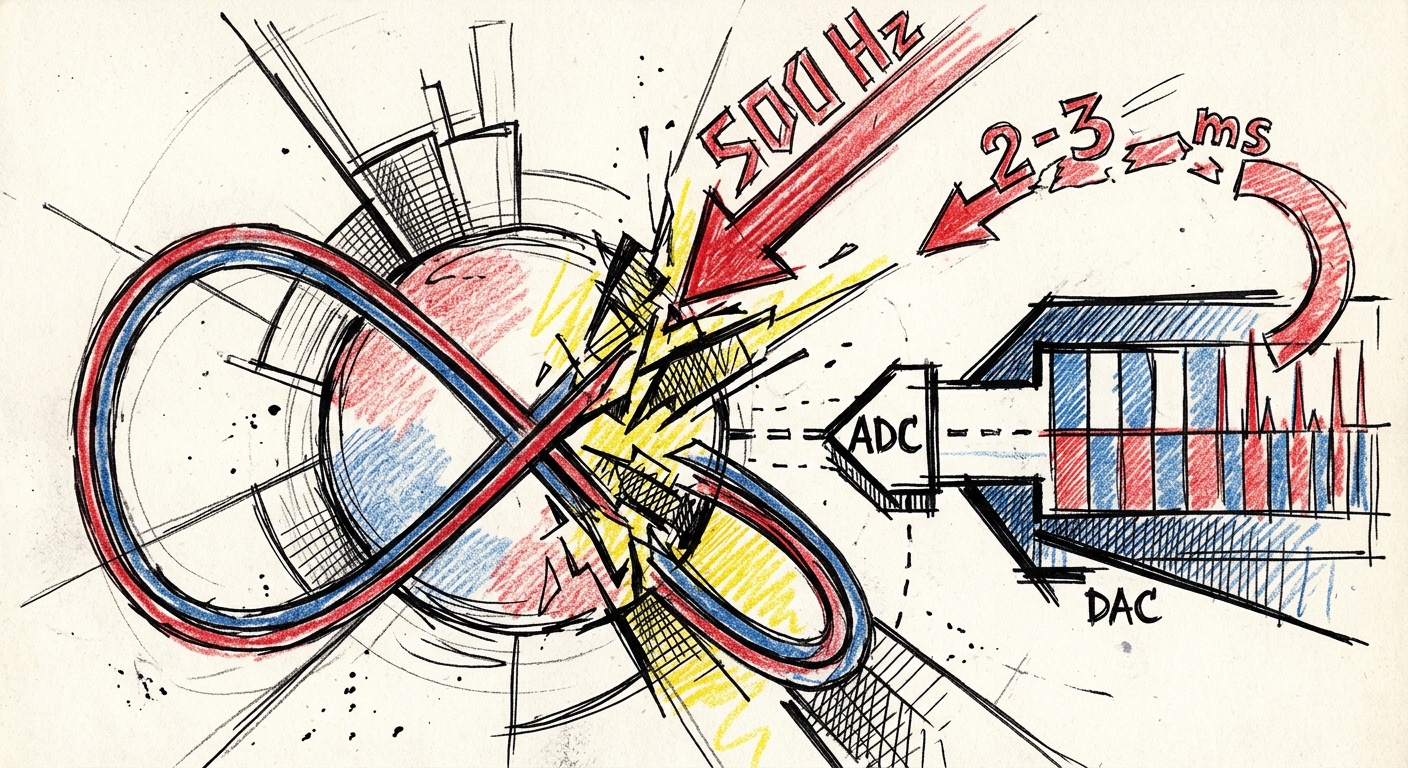
Electrically identical to generic bipolar CV. The challenge lies in latency: the delay through ADC → DSP → DAC determines the feedback behavior.
Use Cases
- Chaotic sound effects (self-oscillating systems)
- Feedback FM (oscillator modulates itself)
- Saturation and compression
- Experimental/generative sound design
Hardware Implementation
Standard Input Stage: OpAmp → Mux → ADC
Identical to generic bipolar CV.
Latency Problem (critical!)
- Total latency: ADC sampling + mux settling + DSP buffer size + DAC output
- Typical: ADS8866 (~1μs) + Mux (~1μs) + DSP (depends on block size, e.g., 1ms at 48kHz/48 samples) + PCM5102A (~0.5ms internal FIR filter) = ~2–3ms total latency
- Effect: >1–2ms latency → feedback behaves not like analog feedback (chaos/saturation), but like a comb filter. At 2ms latency, a fixed resonance appears at 500 Hz (f = 1/0.002s), giving the signal an extremely metallic/hollow, digital character.
- In DSP terms, this corresponds to the z^(-N) delay element. For true chaos-based analog feedback, block processing (buffer size > 1) would need to be abandoned in favor of sample-by-sample processing — very CPU-inefficient.
Strategies
- Feedback in software: Implement feedback path entirely internally (without DAC→ADC roundtrip) — eliminates hardware latency completely.
- Minimize latency: Small DSP buffers (e.g., 1 sample), DMA, no mux waiting. Practically hard to achieve below 0.5ms.
- Latency as feature: Deliberately use the comb filter effect (Karplus-Strong, delay-based synthesis).