
Gate
| Property | Value |
|---|---|
| Category | Logical / Time-Based |
| Voltage Range | 0..+5V (tolerant up to +12V) |
| Polarity | Unipolar |
| Bandwidth | <1kHz |
| Threshold | ~0.7V–2.0V (module-dependent) |
Description
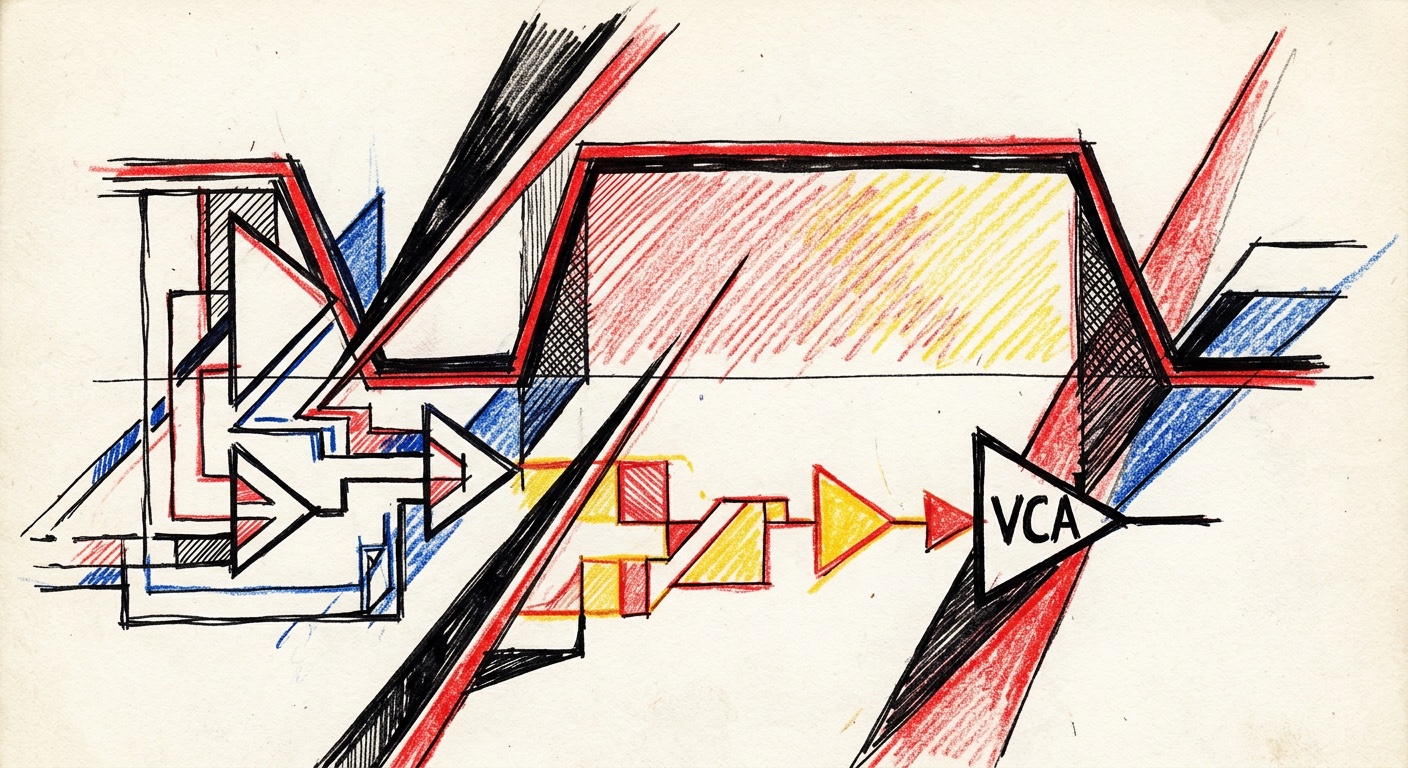
A gate signal represents a high/low state with a musically relevant duration. Unlike a trigger, not only the edge but also the time spent in the high state is significant — it corresponds to the "note-on" duration.
Track & Hold vs. Sample & Hold: S&H requires a trigger (freezes value immediately). T&H requires a gate (follows the signal while gate is high, freezes on low).
Use Cases
- Hold the sustain phase of an ADSR envelope
- Open a VCA (note sounds as long as gate is high)
- Activate a freeze function (e.g., freeze a buffer)
- Start/stop control
- Open a low-pass gate (LPG)
- Control track & hold (follow signal on high, freeze on low)
Eurorack Examples (Mutable Instruments)
- Clouds: FREEZE input freezes the audio buffer while gate is high
- Rings: Gate at STRUM input holds the resonator in sustain
- Stages: Gate duration determines hold time of segments
Hardware Implementation
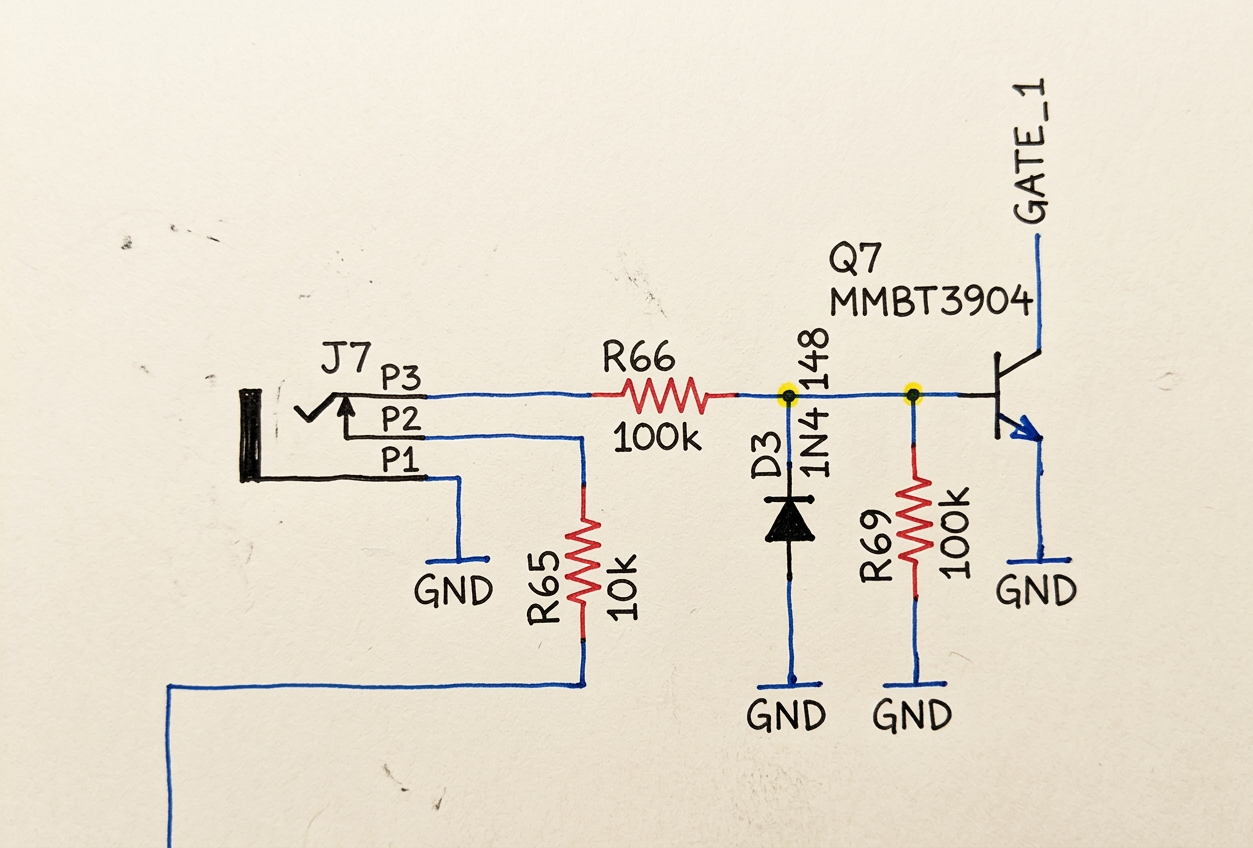
Identical to trigger — GPIO with NPN transistor or BAT54S clamping. The difference lies solely in firmware interpretation.
Firmware Requirements
- Polling in block-rate interrupt (preferred): Sample gate state at 1–3kHz (coupled to audio block size). Polling is superior to EXTI for gates, because an EXTI interrupt storm will overwhelm the CPU when a user patches an audio signal into the gate input (which happens regularly in Eurorack).
- Alternatively: EXTI on both edges (rising + falling), but only if high-frequency signals at the input can be ruled out
- State variable for current gate status (high/low)
- Software debounce: State must be stable for 2–3ms before an edge is recognized. Especially important with mechanical controllers (Keystep, pedals) that can bounce.